How to Prepare for a Trail Race: Race-Day Lessons From Ultra Runner Ido Dassa
- #podcast
- #trail-running
- #ultra-running
- #race-strategy
- #nutrition
Two runners can look at the same race stats. Same distance, same elevation gain, same elevation loss. One finishes in six hours. The other finishes in sixteen.
That gap is the whole problem with trail racing, and it is what Ido Dassa has spent a decade learning to close.
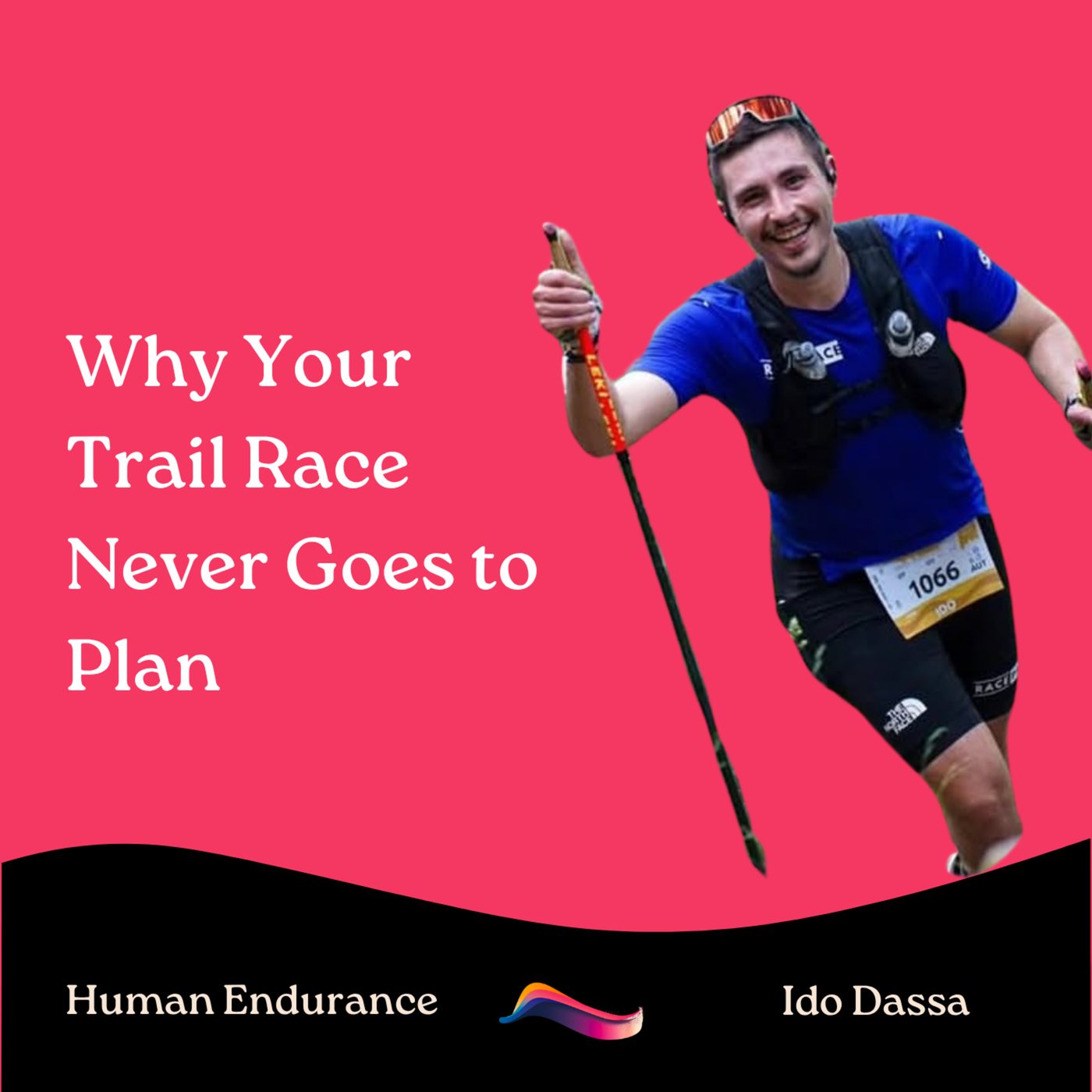
Ido is a pro ultra-trail runner based in Vienna. He is the Israeli 100 km champion and national record holder, a member of the Israeli national trail team, and a The North Face athlete. He is also CEO and co-founder of RacePace, the AI race-strategy platform for trail and ultra runners, and Official Race Planner Partner of HOKA Val d'Aran by UTMB.
He also started running at 18, as a smoker who had never played a sport. We think that matters. Nothing he says here comes from natural talent.
In this Expert Series episode of Human Endurance we asked him a simple question. What actually decides a trail race? Here is what he told us.
Why Trail Running and Road Running Are Not the Same Sport
Trail running and road running use the same verb but make different demands on the body. Muscle groups, movement patterns, effort management and pacing logic all change once the ground stops being flat and predictable.
Ido is direct about who struggles most with this. It is not beginners. It is experienced road runners.
“I think it's a bit misleading because physically it's just a different sport.”
Beginners arrive curious. They watch videos, read, ask questions, and treat the trail as something new to learn. Road runners arrive with a marathon PB and a pacing strategy that has worked for years. That strategy pushes them too hard on the first climb, leaves them with wrecked quads for the descent, and turns the rest of the race into survival.
His advice for anyone crossing over is to unlearn first. Paces still matter, but they have to be translated. Learn what grade adjusted pace means. Learn how gradient changes your effort. Learn that walking is not failure on a climb, it is often the faster and more efficient choice.
What to Look For in a Race Course Profile
Look past the summary stats. Distance and total elevation gain tell you almost nothing on their own, because two courses with identical numbers can produce completely different races.
What actually changes the outcome:
- How the elevation is distributed. A 50K with 30 flat kilometers followed by one enormous climb requires a different plan than a 50K of constant rolling terrain. Mismanage the flat section in the first case and you will not make it up the mountain.
- Terrain quality. A section that looks flat on the elevation graph can be dense with rocks and roots. Ido has had sections he budgeted an hour for take two and a half.
- Recent and forecast weather. Rain the day before turns a straightforward dirt descent into mud. That alone can cost an hour.
- Altitude above sea level. If you live at sea level and the course sits high, acclimatization becomes part of the plan, not a detail.
- Distance between aid stations. On trails this can be hours, not five kilometers. Everything you need in between is on your back.
Get any of these wrong and the error compounds. A section that takes twice as long as planned is also a section where you carried half the calories and water you needed.
The Mental Cost of a Race That Does Not Match Your Plan
Ido makes a point we had not heard framed this way before. The damage from a bad course prediction is not only physical. It is a mismatch between the race you visualized and the race you are in.
Every runner builds a mental film before race day. How the climb will feel. What the finish will look like. When the real race diverges sharply from that film, the mind starts to unravel before the legs do.
“At the moment that this bad thinking or negativity comes into your head, it's usually going only towards one direction.”
He believes this is what separates good ultra runners from the rest. Everyone gets the dark patch. Everyone. The skill is getting out of it, and he says there is no permanent solution. What worked in one race can fail in the next.
How to Manage Effort on Uphills
Use effort as the trigger for walking or running, not gradient. The target is an effort you feel you could sustain more or less forever, with a small amount added on race day.
In practice this means the switch moves with the terrain. On a gentle early climb, running holds that effort fine. When the trail steepens or turns technical, cadence rises, heart rate climbs, and walking becomes the way to hold the same effort. Ido's internal instruction on every climb is the same three words, repeated: do not push.
The reason is eccentric loading. Climbing and descending draw on the same muscle groups. Spend too much on the way up and the descent, where the real time is available, becomes damage control.
Poles, Hands on Quads, or Hands Behind the Back
There are three common positions on a climb, and each does something different.
- Poles. Distribute load to the upper body and reduce strain on the lower back. Ido uses them and rates them highly for long races. They need coordination and practice.
- Hands on the quads, just above the knees. Adds upper body force to the movement and keeps the chest open for breathing.
- Hands clasped behind the back. Common in Europe, borrowed from hiking. Straightens the back and opens the chest, but you lose the ability to push with the arms.
None of these is correct in the abstract. Try all three in training and keep the one your body agrees with.
How to Run Downhill Without Wrecking Your Race
Split descents into two categories, because they need different preparation.
Runnable descents are non-technical. Anyone can run them. What limits you is quad conditioning, and that can be trained either by running downhill or in the gym. Ido points out that some elite athletes race enormous descents on gym work alone.
Technical descents are a coordination skill. Foot placement, eye-leg speed, angle judgment, all at pace. It can be trained, but some runners simply arrive with it.
This is also where trail running gets genuinely dangerous. At a race in Austria the week we recorded, Ido passed two runners on a single descent who had been faster than him on the climbs. One dislocated a shoulder. The other sprained an ankle badly enough that he could not weight it. Both were evacuated by helicopter.
His position is unambiguous. If a descent is beyond your skill, go slower and lose the time. The price of the error is not sore quads. It is an injury.
How Much Should You Eat During a Trail Race
There is no universal number, and the numbers circulating on social media are a trap. Ido is blunt about the 120 grams of carbohydrate per hour figure that elite athletes post: most amateurs attempting it will be stopped at the side of the trail within two hours.
What he recommends instead:
- Treat gut training as its own session. Some long runs exist to test fueling, not fitness.
- Document what worked and under which conditions. Weather and intensity change what your gut tolerates. So does time. What worked for him three years ago does not work now.
- Always build a plan B. Taste fatigue, cold hands, a missing aid station. Assume something fails.
- Remember that carbs are not the whole picture. Water and sodium determine how much of what you eat you actually absorb.
He also flags gastrointestinal problems as a leading cause of DNFs in trail racing, and it is the reason his team is now building nutrition planning around weather and effort rather than the athlete's preferences alone.
The Race Where Everything Stacked Up
Ido has DNF'd, and the story is useful precisely because no single mistake caused it.
He was underdressed for overnight cold in the mountains. Soaked and still moving, his body spent everything it had staying warm. He had come from sea level to altitude without acclimatizing. His hands were too cold and wet to open gel wrappers, so the fueling plan quietly stopped happening while he climbed.
Each of those on its own is survivable. Together they ended his race at 50 kilometers of 100, and he needed medical attention for his breathing afterwards.
“Top 10 or go home,” is how he described his filter as a professional that day.
What This Means for Coaches
Ido's closing advice was aimed directly at coaches, and it is short.
Understand the demands of the race first. Then build the plan backwards from them.
He says plans too often begin with a generic base period and never become specific to the event the athlete actually signed up for. The reason is not negligence, it is time. Building a real course strategy took the coaches he spoke to hours or days per athlete, so it frequently did not happen at all. Months of structured training, and then the athlete goes into the most important day of the season without a plan.
That gap is the one worth closing. It is also the reason we built augo, and the reason RacePace exists.
Listen to the Full Episode
Available now on Spotify, Apple Podcasts, and YouTube — listen to the full conversation.
In this one we cover:
- How he went from sedentary and smoking at 18 to racing professionally
- Why he trains almost entirely alone, and how he links that to a decade without serious injury
- The three uphill hand positions and what each one actually does
- How RacePace builds race strategies from training data and course data
- How coaches use the platform to review and approve plans before athletes see them
Connect with Ido
findracepace.com / @find_racepace / @ido_dassa
Connect with Us
Bruna: @justbrunathings / Fabi: @endurance_fabi
Our startup: www.augotraining.com
Be coached by us: www.jornadaendurance.com
More about the podcast: www.humanendurancepodcast.com
Frequently asked questions
How is trail running different from road running?
Trail running places different demands on muscle groups, movement patterns and effort management. Pace becomes an unreliable guide because terrain, gradient, surface conditions and altitude change how much effort any given pace costs. Walking uphill is often faster and more efficient than running.
How do I know when to walk instead of run uphill?
Use effort, not gradient. Hold an effort you could sustain for a very long time. When the terrain steepens or becomes technical enough that maintaining a run pushes your heart rate above that level, switch to walking.
Should I use poles for trail running?
Poles distribute load to the upper body, reduce lower back strain and help manage effort over long races. They require coordination and practice. Alternatives are hands on the quads or hands clasped behind the back, both of which open the chest for breathing.
How many carbs per hour should I eat in an ultra?
There is no universal number. The 120 grams per hour figure shared by elite athletes is far beyond what most amateur runners tolerate. Find your own number through dedicated gut training sessions, and record how it changes with weather and intensity.
Why do runners DNF in trail races?
Gastrointestinal problems are one of the most common causes. Others include pacing errors from misreading the course, carrying insufficient calories or water for sections that took longer than planned, inadequate gear for conditions, and lack of altitude acclimatization.
What should I look for in a trail race course profile?
How the elevation is distributed across the course, terrain quality on sections that look flat, recent and forecast weather, altitude above sea level, and the distance between aid stations.
Listen to the full episode
Why your trail race never goes to plan