Your Injury Didn’t Start When It Started Hurting
- #podcast
- #injury-prevention
- #cycling
- #running
Hey there!
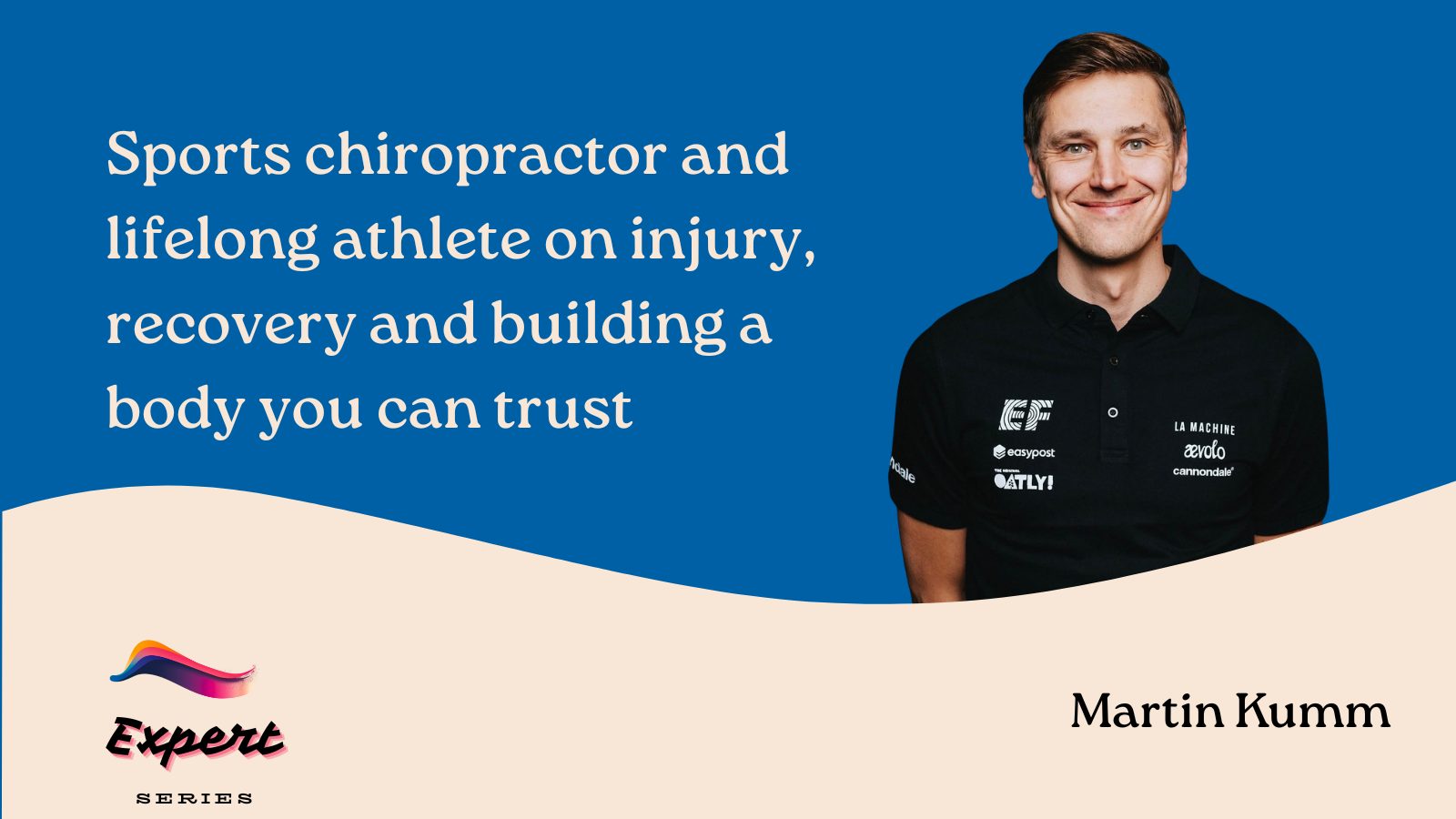
This week on the Expert Series we sat down with Martin, a sports chiropractor who has spent the past five years working with EF Education-EasyPost, one of cycling’s WorldTour teams. Before that he spent years in ice hockey, including with the Estonian national team, and several years traveling with a track and field squad in Switzerland.
He qualified in the UK in 2013 and has been an athlete his whole life. National level basketball first, then triathlon, and eventually cycling, after deciding that swimming and running were never going to be his strengths. He is Estonian, has lived in Basel for thirteen years, and has worked with sprinters and Grand Tour riders in the same career, which gave him a useful habit of comparing populations that rarely get compared.
We asked him the questions our athletes ask us constantly. He did not give safe answers.
Pain is a Lagging Indicator
The model he works from is simple. There is load, and there is capacity, and injury happens where they stop matching.
“You have the load, you have the capacity, and then when these are not matching, you will have injury or you don’t have injury.”
Capacity here means tissue. Ligaments, tendons, muscles, bones. When the load going through a structure exceeds what that structure can handle, the inflammatory process starts, and the inflammatory process is what you eventually feel.
The part worth sitting with is the timeline.
“Most often the pain didn’t start three days before or that day when you started to feel. That pain actually has been there since long, long, long time. It’s just your brain is so clever machine that it will find way to compensate as long as it’s possible, and at one point when it’s not possible, it starts to break down a bit and a bit and a bit until the point that the tissue actually gets damaged.”
So the niggle is not the beginning of the problem. It is the moment your compensation strategies ran out.
The One Leg Test
The most surprising thing he told us was that he can identify a rider’s childhood from a single static position.
“I can ask a rider stand on one foot, and I can tell if that cyclist has done any other sports besides riding their bicycle since they are the kid.”
We asked how. His answer was that they can be among the best riders in the world and still fall over.
“It’s sad, but it’s true. But they can be the best riders in the world, but if you put them on one foot and they cannot balance there, you know that they have not done much when they were kids.”
His reasoning is that walking is a one leg movement and running is a one leg movement. If you cannot hold the static version, the dynamic version becomes a chain of compensations.
“If you can’t stand as a static position one foot, the running itself already becomes a one compensation pattern after the other because the brain is trying to figure out as it goes along how to survive this next five minutes, ten minutes, and so on.”
Try it while you read this. It costs nothing and it tells you something.
Why Runners Who Add Triathlon Often Get Injured Less
Bruna asked about something we have both noticed. Athletes who move from running only into triathlon frequently report fewer injuries, sometimes at the same run volume. Martin recognized the pattern immediately.
“The athletes who have been exposed to different sports have much more robustness also later in their careers. And the athletes who were very young, already very good, they are very good at one thing or one of few things, but they cannot do anything else, and then the body starts to break down.”
His explanation is neurological rather than mechanical. New sport means new inputs, and new inputs force the brain to learn.
“The brain is incredible about learning new things if you put it in the environment, and the environment is not too challenging. If it’s not too fast. If it’s too fast, it will break down, it will fall, and it cannot handle it. But if you do this slowly, give enough repetition and time, the brain will adapt to most things it can adapt.”
He was clear that this does not close at thirty. It gets harder, not impossible.
“Even if you are in your 50s and 60s, you can pick up new activities.”
The Classics, Answered
We ran through the list of questions that never go away.
Warm up. It depends entirely on what the session is for. He pointed out that the sprinters he worked with warm up longer than they train, sometimes ninety minutes to two hours for six sets of sixty meters, because there is nothing neurological left in the tank afterward. A cyclist heading out for a three hour endurance ride does essentially nothing beforehand. Both are correct. For amateurs he suggested some kind of activation routine before anything hard, and for runners specifically he likes jumps, hops and pogos.
“Your brain is also ready because the brain needs the information from the feet.”
Stretching. There are athletes who should and athletes who should not, and it comes down to where you sit on the mobility spectrum.
“When you have a lot of mobility, I think the stretching is not gonna be a solution for you in long term in terms of performance. You need more stability there because the joints need stability.”
Stiff athletes need to stay mobile. But he would rather they moved than held.
“If it’s possible, I would always add a movement into a stretching routine rather than just holding for 30, 40 seconds one position.”
Cool down. Small effect, and probably not where your time should go.
“If you have to choose spending 30 minutes stretching afterwards versus you get to sleep 30 minutes earlier, I would say take the sleep.”
He does think it matters for riders on the rollers after a Tour stage, where five to ten percent is worth having. For the rest of us, it competes with sleep and loses.
Strength training. Important, and the research keeps pointing that way, both for performance and for staying healthy. But he would not swap out a long endurance session for it under normal circumstances. He would find twenty or thirty minutes for one or two specific things instead. What changed his thinking was watching what happens to riders during a three week race, when there is no strength work possible at all.
“The strength component goes so far, so quickly down actually.”
Which is why the off-season block model has been losing ground in pro cycling.
“Consistency here is also better than two months a lot.”
Bruna made the same point from her own training. An hour in the gym is a big ask on a busy day. Fifteen minutes and three exercises is not, and it adds up to more strength work overall because it actually happens.
Supplements. He was careful here, and he declined to name brands. On magnesium, his point was about absorption rather than levels.
“You might take 500 milligrams worth of product, but what you actually absorb from there is much, much, much less.”
He also raised something we were not expecting, which was omega-3 testing, and specifically its value as a window into immune function.
“When you have a good immune system, you’re gonna stay healthy longer. The longer you stay healthy, you can train again.”
On creatine, he takes it daily, no loading and no cycling, and thinks the recent research on cognitive function is more interesting than the original bodybuilding case.
“Generally speaking, I think it’s worth the try, especially considering how cheap it is.”
Cold and heat. This one stung slightly, because we own a cold plunge that we bought when the research looked better than it does now. His read is that cold immersion has a short term effect on how you feel tomorrow and a less favorable long term picture, because of what it does to protein resynthesis after hard work.
“If you’re looking for a long-term performance gain, less likely to have anything from it.”
Heat is where the current evidence looks better for endurance athletes.
“If you need to use and if you wanna use something, then probably you will get more out of a heat training than from the cold training.”
He also gave us an out, which we are taking.
“At the end of the day, if you like it, if you like the sensation, then for us amateurs, the few percent here and there, I don’t think it’s gonna make a big difference on your race day.”
Feet, and Why Cyclists’ Knees Hurt
This is the part he could have talked about for another hour, and probably will when we get him back.
The core distinction is what the foot is asked to do in each sport. In running it absorbs and then returns force. In cycling it is locked into a stiff carbon shoe and only absorbs.
“On the running, it’s absorb and explode. On the cycling, it’s basically just absorb and nothing else happens.”
Spend six or seven hours a day in that shoe and the foot takes on the shape of the thing containing it.
“The foot itself will deform into positions of that shoe shape, which is not anatomical and that’s also not functional. Then you take it out and you expect when you walk that foot will do the job it’s designed to do.”
His view is that a meaningful share of the knee injuries he sees in cyclists start below the knee.
“A lot of the knee injuries I see in cycling stem from is actually from the foot.”
On plantar fasciitis, he reframed it entirely. We had assumed heel, arch, calf. He looks at the toes.
“When the toes curl too fast and too high, it’s gonna put pull on the fascia, and when it puts pull on the fascia, it starts pulling basically from the heel forwards. So it becomes not the heel problem, it becomes a forefoot problem.”
Which explains why the standard approach so often fails.
“That’s why a lot of the standard models that we work on the calf or work passively on the fascia itself, it doesn’t work until you understand the mechanics.”
On shoes, he was less deterministic than we expected. A narrow toe box locks the foot into a position where it cannot elongate. Too much room and you slide and grip. But he did not think either was likely to be the root cause on its own. He would look at how the toes sit when you are simply standing.
“It doesn’t necessarily have to be even to do with running. Running is just putting extra load on it and then just accelerates the whole process.”
His Advice
We always close the same way, with one thing for coaches and one for athletes.
For coaches, he wanted to change the question being asked.
“It doesn’t become so important how you can prevent injuries per se, it more becomes a question like how you can build a robust athlete and as robust athlete as possible. Give them a vast variety of activities, different challenges for the brain to work with, and the likelihood is much, much less.”
Athletes who are broadly built handle load. Athletes built narrowly, including athletes whose entire focus has become staying healthy, do not.
For athletes, he came back to the timeline.
“Injuries don’t happen overnight. It’s a process, and the earlier you get onto that process, the less likely you are that the injury gets that far that you need to take time off.”
And then the harder part, which is that the information is usually available before the injury is.
“We are so good at just like, let’s get this session done, it’s gonna be different or better tomorrow. But the signs are there, we’re just not listening to that, and the earlier you start listening to these small signs, the less likely is that you’re gonna run into a concrete wall at some point later on.”
He described what it looks like when someone arrives too late. Someone in a clinic has to deliver a message about time off or changing course, to a person who is locked into a goal and not prepared to hear it.
“You still wanna do what you wanna do, but your body is not capable of doing what you wanna do.”
Neither of us is especially good at this. Taking an unplanned rest day still feels like a red mark on the calendar. But the argument is hard to dismiss, because the alternative is a longer stop later.
Listen to the Full Episode
Available now on Spotify, Apple Podcasts, and YouTube — listen to the full conversation.
In this one we cover:
- The load versus capacity model, and why pain shows up months after the problem does
- The one leg test, and what it reveals about an athlete’s movement history
- Why varied childhood movement shows up in adult injury patterns
- Why runners who add triathlon often get injured less at the same run volume
- How to match warm up length to session intent, and what sprinters do differently
- Who should stretch, who should not, and why movement beats static holds
- Whether a cool down is worth your time, or whether sleep is the better trade
- Fitting strength training around endurance volume, and why short and consistent wins
- Magnesium absorption, omega-3 testing, and his take on creatine
- Cold water immersion versus sauna and heat exposure
- Why cyclists’ knee pain often begins in the foot
- Plantar fasciitis as a forefoot problem rather than a heel problem
Nothing here is medical advice. If something hurts, see someone who can look at you in person.
Connect with Martin
cycling.clinic/ride-ready / @martinkumm_cycling
He has also written a knee booklet for cyclists, with tests you can work through and space to record what you find, plus a set of starting exercises.
Connect with Us
Bruna: @justbrunathings / Fabi: @endurance_fabi
Our startup: www.augotraining.com
Be coached by us: www.jornadaendurance.com
More about the podcast: www.humanendurancepodcast.com
Listen to the full episode
Sports chiropractor and lifelong athlete on injury, recovery and building a body you can trust