From Medical Student to IRONMAN 70.3 AG World Champion: Samuel Studer
- #podcast
- #triathlon
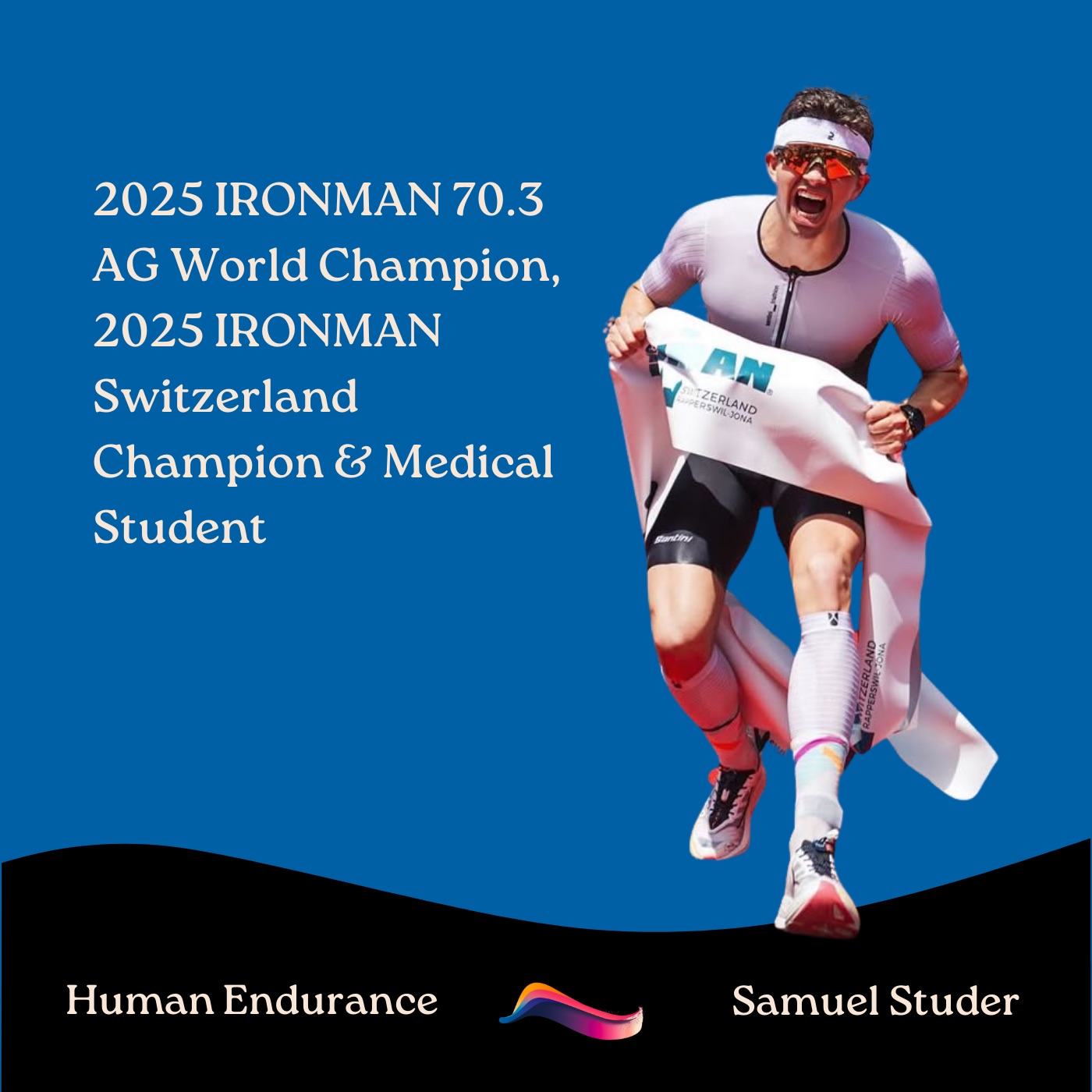
We sat down with Samuel Studer, the 2025 Ironman 70.3 Age Group World Champion who’s also a medical student at the University of Zurich. We wanted to understand how someone manages 20-24 hours of training per week while studying medicine, and what it took to reach the top of the podium.
What he shared was honest—not sugar-coated success stories, but the real challenges of switching sports multiple times, difficult conversations with family, and a race day that almost fell apart completely.
When we asked how he knew middle distance was right for him after years of short course, his answer was simple: “I noticed when I did sessions that were longer and steady, I could perform a lot better. My power profile was very flat. I thought I would give middle distance a shot and I definitely don’t regret it.”
One switch became a World Championship. Not through perfect planning, but through listening to his body and having the courage to advocate for what he needed.
Below are more insights he shared with us during this conversation.
Training That Works For Your Body
One of the most interesting parts of our conversation was Samuel’s training methodology, which is heavily inspired by Brett Sutton’s approach.
His coach focuses on RPE-based training rather than purely science-driven metrics. It’s about consistent, hard training with a strong emphasis on feel.
“We don’t, we’re not very science based. It’s more like consistent hard training. And that’s really what got me through,” Samuel explained.
The breakthrough came from double bike sessions. Every Wednesday during his buildup to Marbella:
- Morning: Big gear work—8 x 5 minutes at 50-55 RPM
- Afternoon: A build session—30 minutes medium, 30 minutes “mad bad” (basically all-out)
“It was very, very hard, but I got so much out of it, and that’s really what got me going week by week. ‘Cause I noticed I’m improving every week.”
Then Sundays were race-specific: 2.5-hour bike with intervals, followed immediately by a 17-18K run. Hard. For five consecutive weeks.
Could he sustain this year-round? No. But for a focused buildup to Worlds, it was exactly what his body needed.
When Everything Goes Wrong on Race Day
Samuel’s World Championship race in Marbella didn’t go according to plan.
His age group started almost two hours after the first wave. The swim was chaotic—mass start with bodies everywhere. In T1, he couldn’t find his transition bag, then couldn’t find his bike. Lost at least a minute.
On the bike, he was crushing it with his best-ever normalized power (349 watts). Then he lost a bottle—the one with a significant portion of his nutrition.
“I didn’t have enough carbs in reserve,” he said. The consequence showed up in the run.
After 15K: “It was really getting very hard.”
The last 2K: “I was barely on my feet. I was stumbling all the last two kilometers.”
He had no idea where he stood. Athletes were passing him. He couldn’t process information anymore.
“The last five kilometers, I wasn’t thinking about myself or the win. I was just thinking about really giving it my all, especially for my family.”
He crossed the finish line, went straight to the medical tent, and waited. When someone finally told him he’d won—by two minutes—he broke down in tears.
“I really thought I lost my first place in the last few kilometers.”
The Courage to Speak Up
Samuel’s path to triathlon required multiple difficult conversations.
First, telling his parents he wanted to leave competitive swimming—where he was on track for a professional career—to try triathlon.
Then, a year later, realizing short course wasn’t his discipline and needing to switch to middle distance. This meant new equipment: a TT bike, aero helmet, all the nutrition for longer races.
“I was kind of hesitating to tell them because I wasn’t in a position to finance all of this myself,” he explained.
But he did it anyway. And his parents supported him.
“I owe my parents a lot. They’ve been so supportive, like in every aspect—not only financial, but also emotional. They’ve been at every competition this season.”
The lesson isn’t about equipment or money. It’s about having the courage to speak up for what you need, even when it feels like too much to ask.
“A big part of why I had this success is because I’ve had the courage to speak up and do what I believe is best for me and gets me the furthest.”
Balancing Medical School and Training
When we asked how he manages medical school with 20-24 hours of weekly training, Samuel was direct:
“I think saying ‘I don’t have time’ is not a good excuse. I never say I don’t have time. I always say it’s just a matter of how you set your priorities.” - Samuel
At the University of Zurich, medical students don’t have mandatory classes to attend—it’s self-directed learning with required material to cover and exams to pass.
“That’s where my discipline comes in very handy. If you’re very good at studying on your own and showing up for yourself, then you can manage both.”
He trains during available time slots and studies around it. When he had hospital rotations, he adjusted. During his Marbella buildup, he had more flexibility and went all-in.
“Time management is important, but setting your priorities is probably even more important.”
Next year will be harder—he starts full-time hospital rotations in January while turning professional in triathlon. He’s honest that he doesn’t know yet how it will work.
But he’s committed to trying. His childhood dream of being a professional triathlete was always just that—a dream, not a goal, because it didn’t seem realistic.
Until now.
Samuel’s Advice: It’s About Priorities
We asked Samuel what advice he’d give to athletes trying to balance academics or demanding careers with athletic ambitions.
“A big part of why I had this success is because I’ve had the courage to speak up and do what I believe is best for me and gets me the furthest. Those decisions may not seem very hard for some people, but for me they were very hard.”
He continued: “People like us can do it, then other people can also do it. I think saying ‘I don’t have time’ is not a good excuse. It’s just a matter of how you set your priorities.”
“If these priorities are really getting you to where you want to be, and where people like us can do it, then other people can also do it.”
Listen to the Full Episode
This newsletter covers the main themes, but there’s a lot more in the full conversation:
- Samuel’s competitive swimming background and national team experience
- The transition from pool to open water racing
- His nutrition mishap in Marbella and what he learned
- Specific training week structure during his buildup
- His plans for Ironman full distance
- The sponsorship side of turning professional
🎧 Listen on Spotify or Apple Podcasts
📺 Watch on YouTube
Connect with Samuel
Instagram: @samuel_studer
Connect with us
Instagram: @justbrunathings, @endurance_fabi
Website: www.humanendurancepodcast.com
Originally published on Substack. Subscribe there to get new posts by email.
Listen to the full episode
2025 IRONMAN 70.3 AG World Champion, 2025 IRONMAN Switzerland Champion & Medical Student