Why Cross-Training Might Be the Most Underrated Tool in Endurance Sports
- #podcast
- #cross-training
- #coaching
Hey there!
We’ve just released a new episode of the Human Endurance Podcast.
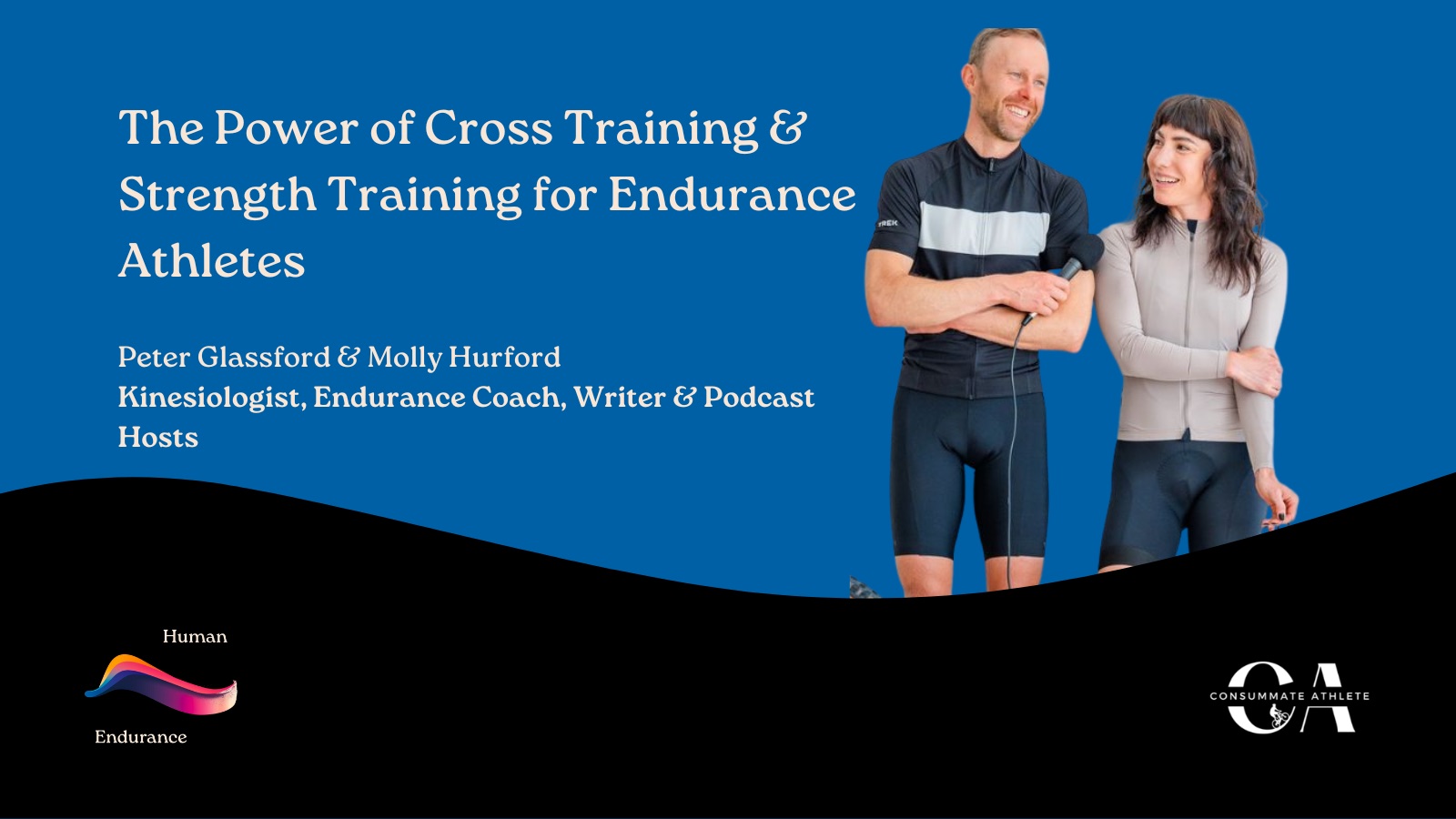
This time we sat down with Peter Glassford and Molly Hurford, the couple behind The Consummate Athlete podcast. Peter is a Registered Kinesiologist and endurance coach with over 20 years of experience. Molly is an ultra runner, journalist, and founder of Strong Girl Publishing. They met at a bike race in China 13 years ago (yes, really) and have been working, podcasting, and training together ever since.
We wanted to understand their philosophy around cross-training for endurance athletes, how they coach busy people with demanding careers, and what practical lessons they’ve learned from a decade of doing this together. Their 4 Cs framework (Cross-training, Consistency, Confidence, and Community) is something we think every athlete and coach can learn from.
Below are the insights they shared with us during this conversation. Enjoy!
The 4 Cs: Cross-Training, Consistency, Confidence, and Community
Peter and Molly built their entire coaching and content approach around four principles that they’ve seen work across all types of athletes, from development riders to executives training for bucket list events.
The idea starts with cross-training. Not just as a way to supplement your main sport, but as a way to build resilience across all areas of your life. As Peter explained: “We try and encourage people to keep their movements and their mobility as wide as we can, as we pursue specific goals as well.”
What makes their framework interesting is how the four elements feed into each other. Cross-training keeps you consistent (because if you get injured in one sport, you have others to fall back on). Consistency builds confidence. And trying new sports opens up new communities, which creates a support system that keeps the whole cycle going.
Peter shared a personal example: “Most of my time with my friends is spent on a bicycle. And I’m aware of this because I want to have some resilience. If I injure myself and I can’t go biking, I’m gonna lose my whole social structure.” So he deliberately keeps running, gym work, and even piano in his life as a way to diversify both his movement and his connections.
One thing that stood out to us is that they apply this to adults, not just kids. We often hear about sport sampling for young athletes, but Peter made a strong case that adults need it just as much. Our bodies change, our abilities change, our life circumstances change. Having familiarity with multiple sports means you always have options.
Coaching Busy Athletes
A big part of Peter’s coaching practice focuses on what we like to call “corporate athletes,” people with high-pressure careers who travel frequently but still want to train seriously. One of his clients is the Canadian president of a major company who is in a different hotel gym every week.
The approach is practical. Instead of insisting on sport-specific workouts that require specific equipment, Peter builds routines around whatever is available. That might mean uphill treadmill walks (they call them “tread hikes” at 15% grade), cardio machine circuits where you spend five minutes on each piece of equipment, or hotel room conditioning sessions with bodyweight exercises.
“When they come back for the weekend, they can do some bike workouts and not feel like this is the first time they’ve moved in many weeks,” Peter explained. “That consistency is really important for those people.”
He also plans in training blocks. When a client has a stretch of weeks at home, they load up on sport-specific work. When travel hits, they shift to maintenance mode. As Peter put it: “Balance doesn’t come in the days. It might come in the months.”
This resonated with us because it mirrors what we see with many of the athletes we coach at Jornada Endurance. The athletes who succeed long-term are the ones who adapt rather than abandon their training when life gets complicated.
Strength Training: Start Smaller Than You Think
Peter and Molly are big advocates for strength training in endurance athletes, but their approach to getting started is surprisingly minimal.
Peter uses what he calls “one set of eight”: eight exercises, one set each, a couple of times per week. That’s it to start. The whole session takes 10 to 20 minutes. After a month or two, you move to two sets. Then eventually three. And from there, you can take it wherever you want.
The reasoning comes back to what Peter calls the “inverted U.” When you go from doing no strength training to doing a little, the benefit is enormous. But the curve flattens as you add more. And if you start too aggressively, you get so sore that you can’t train consistently, which defeats the purpose.
“A lot of people overthink how much they need to actually just get started with strength training,” Peter said. He and Molly went ten years with just an adjustable dumbbell at home before getting a squat rack.
Molly’s approach is a great example. She started a three-minute yoga routine over ten years ago for a magazine article and just kept doing it every morning. Over time, she added pushups (50 per morning now), planks, bridges for her ankle mobility after an injury, and various other movements. It grew to about 13 minutes per day. That adds up to roughly 90 minutes per week, or 75 hours per year, of strength and mobility work without ever feeling like a separate “strength session.”
For athletes who say they don’t have time for the gym, this is a powerful reframe.
The Problem With ERG Mode
This one will be familiar to any cyclist who trains indoors. ERG mode is the setting on smart trainers that locks your power at a specific wattage regardless of your cadence. Peter has a nuanced take.
The issue, as he sees it, is that ERG mode lets a computer pick the average of a power zone and holds you there for the entire workout. But that assumes the average is the perfect number for you on that particular day, given your recovery state, the heat in the room, your mental state, and the calibration of your trainer. That’s a lot of assumptions.
“A thinking athlete might use the plus-minus buttons to adjust the wattage within the workout, which is a great way to use ERG,” Peter said. But many athletes just set it and zone out. And that creates a gap between training and racing, because in a real event, nobody holds your power steady for you.
His recommendation is to mix in virtual rides where you’re actually shifting, responding to terrain, and making decisions. Not only does this better prepare athletes for outdoor racing, but athletes often find long indoor sessions more engaging when they have something to react to.
Women in Sport and Strong Girl Publishing
Molly founded Strong Girl Publishing to solve a problem she kept running into: publishers telling her that books about girls in sport don’t sell. She didn’t believe that, and she had young women athletes constantly approaching her asking for advice on how to get their own books out there.
The model is collaborative. Each author who publishes through Strong Girl helps promote the others. “When Marley Blonsky’s book comes out, Misha Powell is already talking about it. And Misha’s been talking about the Shred Girls books. They’re all kind of helping promote each other,” Molly explained.
The Shred Girls series, Molly’s own books aimed at younger readers, are essentially the Babysitter’s Club but with bikes instead of babysitting. The goal is to show girls that cycling and outdoor adventure can be for them, especially since the default image in cycling still tends to be older men on expensive bikes.
What struck us was Molly’s own background. She never played a sport growing up. She didn’t start exercising until university. She was, in her words, “a very punk rock bookworm.” That makes her advocacy for girls in sport even more genuine, because she knows firsthand what it’s like to feel like the athletic world isn’t for you.
Advice for Athletes and Coaches
We always close with advice, and Peter and Molly delivered.
Peter’s advice: Be open to cross-training as part of your life, not just your sport. “It can be goofy, it can be specific, it can be an event. But just be open to cross-training.” He shared the example of one of his athletes who got into jump roping with him. It started as something fun, but now it’s building bone density, footwork, and coordination that feeds back into cycling in ways they didn’t expect.
Molly’s advice for someone wanting to tackle a 100-miler: Question your reasons first. Make sure you actually want to do it, not that you feel like you should because someone else did. And then, run most days with moderate volume rather than doing massive weekend runs that leave you cracked for the rest of the week. “My running is very boring. I do the most boring training on the planet, and it works.”
She also shared something Peter added that we loved: set two-year goals. When Molly wanted to do the Leadville 100, her coach David Roche told her she could do it, but if she gave herself three years, he thought she could win it. That long-term thinking is something we try to encourage with our athletes at Jornada Endurance as well.
Listen to the Full Episode
There’s a lot more we covered in this conversation that didn’t make it into this summary, including:
- Molly’s first Ironman disaster and what she learned about fueling
- The story of Molly’s first 100-miler, where she almost broke down before the start and then set the overall course record
- Peter’s take on low-RPM work on the bike vs. gym-based strength
- Cyclocross: what it is, why it’s amazing, and why Belgium treats it like a national sport
- Confidence differences between male and female athletes
- How to get into gravel riding from a road cycling background
Listen on Spotify | Apple Podcasts | YouTube
Connect With Peter and Molly
- The Consummate Athlete Podcast: @consummateathlte
- Peter Glassford: @peterglassford
- Molly Hurford: @mollyjhurford
- Strong Girl Publishing: @stronggirlpublishing
Connect With Us
- augo: www.augotraining.com | @augo.training
- Jornada Endurance: www.jornadaendurance.com
- Bruna: @justbrunathings
- Fabi: @endurance_fabi
Originally published on Substack. Subscribe there to get new posts by email.
Listen to the full episode
The Power of Cross Training & Strength Training for Endurance Athletes