Marginal Gains for Competitive Age-Groupers
- #podcast
- #triathlon
- #coaching
Hey there!
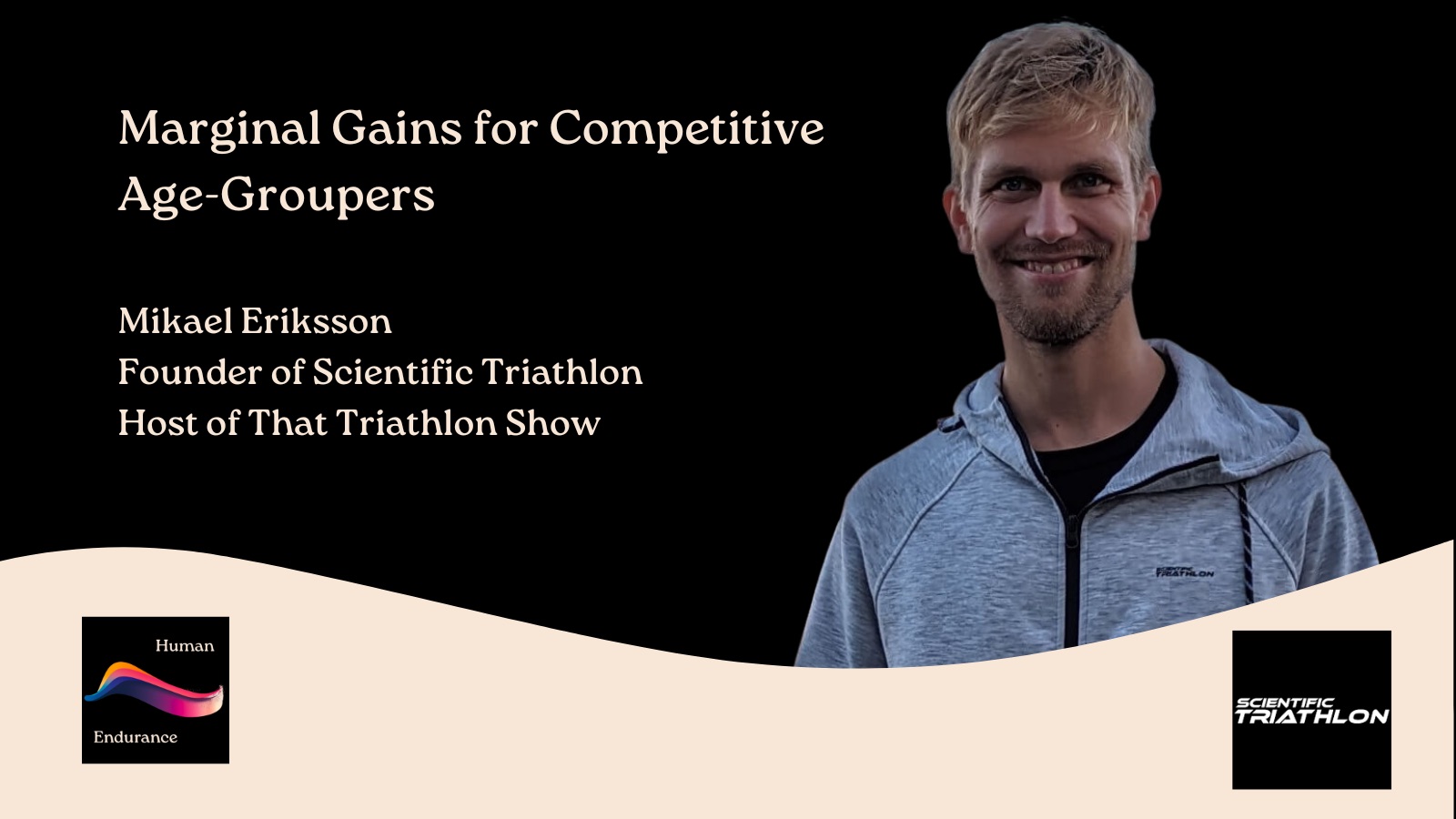
This week on Human Endurance we released an episode with Mikael Eriksson, founder of Scientific Triathlon and host of That Triathlon Show. With nearly nine years of full-time coaching under his belt and a Master’s in engineering, Mikael has worked with athletes across the full spectrum, from complete beginners to professionals racing for World Championship slots.
For this conversation, we wanted to take a slightly different angle than usual. Instead of focusing on how beginners get started, we asked Mikael how athletes who are already strong, already qualified, already consistent, can keep improving. What are the levers that actually move the needle when the obvious gains are already behind you?
Here’s what stood out from the conversation.
It’s Not Complicated. It’s Complex.
One of the most useful reframes Mikael offered came when we were talking about the trade-offs in triathlon training, between three disciplines, recovery, sleep, nutrition, and life itself.
“It is complex because there are a lot of moving parts, but it’s not complicated. It really isn’t. It’s work and it’s recovery and it’s adaptation.”
This distinction matters. Athletes often respond to plateaus by adding more variables: a new tracker, a new nutrition protocol, a new training block someone mentioned on a podcast. Mikael’s observation is that as athletes progress, their training tends to drift in the opposite direction of where it should go. It becomes more complicated rather than more refined.
The highest-leverage coaching intervention for an experienced age-grouper is often subtraction. Removing intensity that doesn’t serve the goal. Reducing total stress so adaptation can happen. Reallocating time across disciplines based on actual return on investment.
The Profile Shapes the Plan
Before any meaningful programming happens, Mikael wants to understand the athlete in front of him. Not just their training history, but their physiological profile.
“You basically want to make sure that your weaknesses are not limiters for you, but you are unlikely to make a weakness a strength. So you’re also well served by continuing to work on your strengths quite a lot.”
He gathers this information through sporting history, race results across distances (a half marathon time alongside a 5K time tells a story), training preferences, and where appropriate, critical power testing. The goal is to figure out whether someone is more slow-twitch or fast-twitch dominant, because that profile changes how you prescribe both endurance work and intensity.
A fast-twitch athlete, Mikael told us, is like a Ferrari. Capable of incredible performance but easier to over-train, harder to recover. They probably should not be doing zone two endurance work every day. A slow-twitch athlete can absorb much more of that stimulus.
Three Metrics That Tell the Whole Story
When we asked about data, we expected a longer list. Mikael’s answer was refreshingly tight.
“Every single session, I want to see an external load metric, which would be pace if you’re running or swimming or power if you’re cycling, an internal load metric, which would be heart rate, and RPE.”
The relationships between these three are what reveal whether an athlete is adapting or sliding toward overreaching. Pace getting faster at the same heart rate, with RPE going down, means fitness is improving. Pace holding steady at a lower heart rate but with rising RPE points the other direction.
What he was less convinced by? HRV trends, sleep stage data, and most of the recovery wearable category. The data may be accurate. The actionable insight, in his experience, often is not.
On Hard Work
This part of the conversation was a useful corrective. In a content landscape dominated by recovery optimization, sleep tracking, and nutrient timing, Mikael’s framing was direct.
“You can become a pretty good athlete with very bad recovery if you’re putting in the work. You cannot fully optimize your recovery and become a good athlete if you’re not putting in the work.”
Recovery matters. Sleep matters. Nutrition matters. But they support the work. They do not replace it. For competitive age-groupers chasing marginal gains, this is worth remembering when the next optimization protocol shows up in the feed.
Mikael’s Advice for Age-Groupers Chasing Marginal Gains
When we asked Mikael what he would tell a competitive age-grouper trying to podium or earn a Kona slot, his answer came back to two things.
First, do not be afraid of hard work. The total volume and the consistency over years matter more than any single session.
Second, look at your training honestly and ask whether it has become overly complicated. Find your few key sessions. Be consistent. Maximize aerobic volume. Resist the urge to change everything when a new podcast episode drops.
“That will take you a long, long way. And I think that most people, even if they’re already competitive, can still go much further with just those couple of things.”
Listen to the Full Episode
The full conversation goes deeper into:
- How Mikael uses critical power testing instead of ramp tests, and why
- Why specificity is overrated for half and full Ironman athletes
- His honest take on the 90 versus 150 grams of carbs per hour debate
- How fasted training fits (or doesn’t) into a serious program
- The tech trends he sees as worth the investment, and the ones he doesn’t
🎧 Listen on Spotify, Apple Podcasts, or watch on YouTube.
Connect with Mikael
Scientific Triathlon: www.scientifictriathlon.com
That Triathlon Show: available on all major podcast platforms and YouTube
Connect with Us
Bruna: @justbrunathings / Fabi: @endurance_fabi
Our startup: www.augotraining.com
Be coached by us: www.jornadaendurance.com
More about the podcast: www.humanendurancepodcast.com
Originally published on Substack. Subscribe there to get new posts by email.
Listen to the full episode
Marginal Gains for Competitive Age-Groupers with Mikael Eriksson, Founder of Scientific Triathlon, Host of That Triathlon Show