Running 100km at 3:47min/km with Pascal Rüeger
- #podcast
- #ultrarunning
- #running
Hey there!
We’ve just released a new episode of the Human Endurance Podcast.
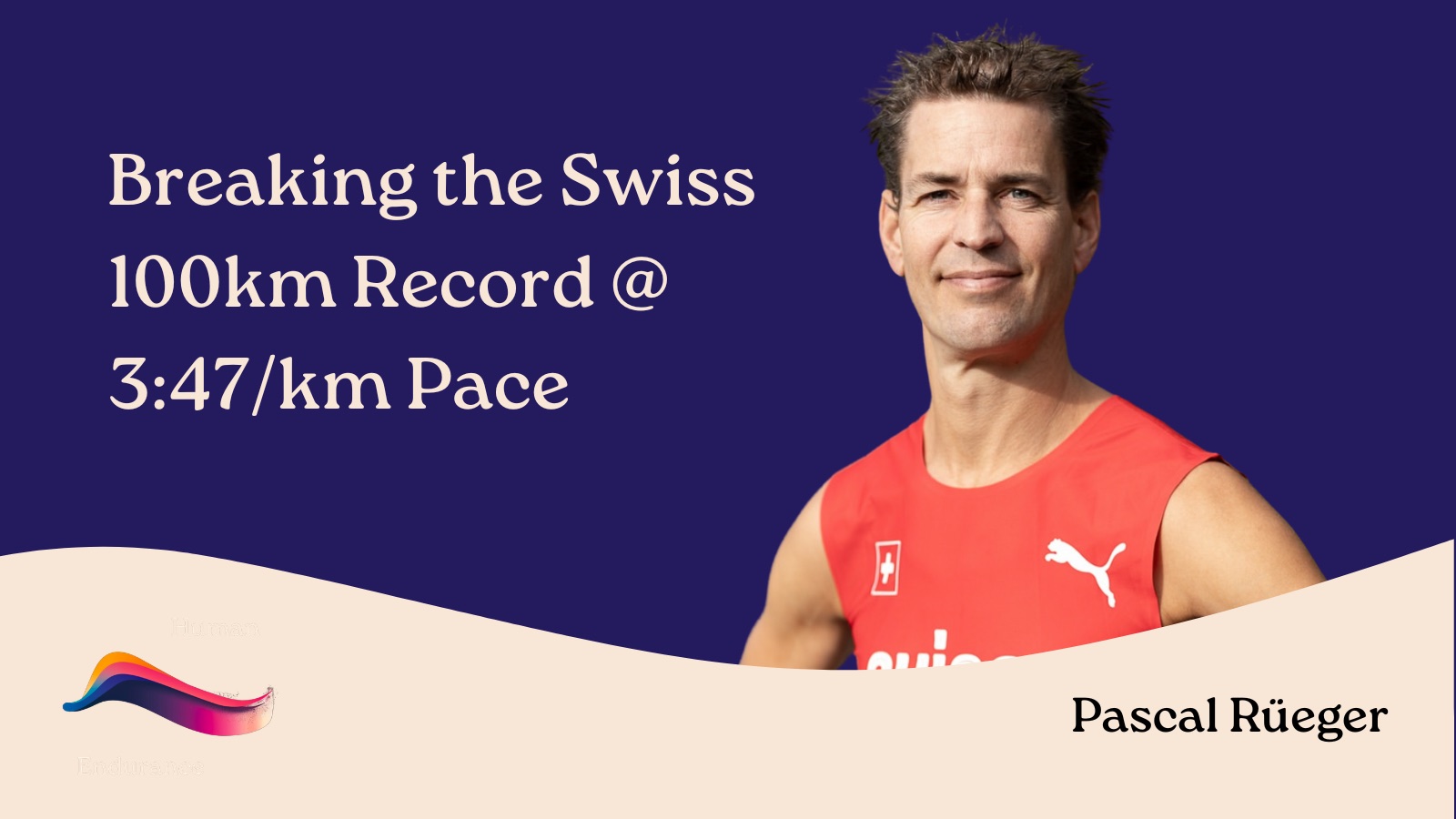
This time we sat down with Pascal Rüeger, known to most people as Swiss Ultra Runner. Earlier this year, Pascal ran 100 kilometers in 6:18:27 at the Ultramaratona del Conero in Italy, breaking the Swiss national record that had stood since 1985 by almost 9 minutes. He won the race by over 30 minutes.
He also holds the Swiss national records for the 6-hour run (91.6 km) and the 12-hour run (161.2 km), the M45 world record for 100km, and the course record at the 100 Miles Berlin. He is entirely self-coached, science-based, and trains twice a day, every day.
What makes Pascal’s story particularly interesting is that he only started running competitively in 2018, in his late thirties. A serial entrepreneur with no athletic background since his teenage years, he went from being out of shape at 36 to one of the most accomplished ultra runners in Switzerland.
Here’s what stood out from the conversation.
The Plan Going Into the Record
When we asked Pascal about race day in Italy, what came through was how much he had already learned about himself before lining up. He had tried to break the Swiss 100km record five or six times. Heat, wind, stomach issues. Something always got in the way.
“My expectation was actually okay. I’m in a very good shape. If everything goes right, I can make it happen. But to be realistic, you fucked up already six times so it can happen again.”
His pacing strategy was built on data and experience: a target around 3:40/km, a heart rate cap of roughly 160 bpm to stay in zone 2, and a fueling plan of 80 to 100 grams of carbs per hour delivered through a mix of gels and drinks on a 10-loop course.
“I knew just shoot out, take the lead and never look back. That’s mostly my mission or how I start a race, and that was exactly what I executed.”
What we found most useful was how he mentally divided the race. He set milestones at 50km, then 60km (”only a marathon to go”), then 70, 80, 90. Each loop becoming a smaller, more manageable target.
“From a rational perspective, it’s a lot. And you can still have cramps or something at kilometer 90, 98, and that’s a bit the tricky part. So you really focus on speed, on nutrition and on everything, and not try to have too much emotions already drop into your running.”
“Every Day Is a Double Rainy Day”
Pascal’s training philosophy is one of the more distinctive approaches we’ve covered on the podcast. He doesn’t follow a 12-week or 16-week plan. He trains all year, mostly twice a day, almost every day.
His normal weekly volume sits between 160 and 200 kilometers. For longer race build-ups (100 miles, 12-hour, 24-hour), he scales up to 240 to 300 kilometers per week and dials back the intensity.
“If you have that in your mindset that every day is a double rainy day, that means you just used to do a session in the morning, a session in the afternoon, and it’s like brushing your teeth. It’s just a thing you do every day twice.”
Within that volume, he keeps intensity simple. Tuesday is the speed session: 400m repeats, kilometer reps, or a double threshold day with morning zone 2 work and afternoon zone 4. The weekend gets a threshold or sub-threshold session, typically 3 to 5km repeats.
Then there are what he calls “Crazy Thursdays.” Back-to-back ultra-specific double sessions that scale through the build: 20+20 km, then 25+25, then 30+30, eventually peaking at 50+50.
“That’s exactly how I train the fatigue. That’s exactly how I train also the mindset to keep continuing if you don’t want to.”
Low-Carb Daily, Carb-Targeted on Race Day
Nutrition is another area where Pascal’s approach is deliberate. Most of his daily training is done low-carb. He sees carbohydrates as fuel for performance, not a default food group.
“During all my training runs, I’m carb targeted. If I have an intense run, I intake all the gels or carb drinks in order to have it in the same way as I have it on the race day.”
On race day, the morning of the 100km record was minimal: black coffee and a bar. Carb loading started the day before, but he keeps it relaxed (toast with Nutella works fine).
“I’m not into eating that much on race day in the morning. So I start with the coffee black and a bar sometimes. And that’s enough.”
From kilometer five onwards, he begins fueling and doesn’t stop, hitting 80 to 100 grams of carbs per hour.
Self-Coached and Science-Based
Pascal is self-coached, but the reason he gave for it isn’t ego. It’s that he reads research and prefers to rely on data rather than instinct.
“Sometimes I have difficulties when people tell me what to do. But I’m really science-based. I read like every paper to improve myself. I truly rely on papers more than I rely on myself.”
He pulls intensity principles from marathon and shorter-distance research, and combines them with the volume and consistency principles that work for ultra. The rest comes from a lot of experience and from being honest about what his body can and cannot recover from.
The Real Superpower
When we asked Pascal what he thinks has allowed him to reach this level in less than a decade, his answer was not about VO₂max or talent.
“I’m probably good at, or the bad thing I’m good at, is I’m really, really resilient. I’m also a serial entrepreneur, so I fucked up a lot of companies. I know how it is to work hard for something and to fail, to fail to fail again and get up and try again.”
This came up again and again in the conversation. The willingness to fail, then fail again, and then come back. For anyone scrolling social media and only seeing the wins, Pascal was honest about the ratio.
“I have much more stories of failing than the winning world. Obviously people want to see me winning, but I have so many fuck ups in running.”
Advice for First-Time Ultra Runners
We always ask our guests for advice for the community. Pascal’s was refreshingly simple.
For someone stepping up to their first ultra: “Just do it. Don’t set yourself too much pressure. Don’t set yourself a goal. You can also do it by a 6-hour run, so there’s no specific target.”
His rule of thumb for weekly volume before a first 100km: “If you have done a weekly mileage as long as your race is, then you are fine. That means if you can run 100km a week, then you can also run a 100km race.”
And on growing into the distance gradually: “I scaled month by month and had to grow with that from mindset. You’re not into 100km from zero to one. You can grow with that.”
Listen to the Full Episode
We covered a lot more in the conversation, including:
- His mental milestones for managing a 6+ hour race
- How he periodizes between 100km road races and longer events
- The shoes he runs in and why
- His first marathon experience (it almost destroyed him)
- His next target: the 12-hour world record (180km in 12 hours) in Etten-Leur, Netherlands
You can listen on Spotify, Apple Podcasts, or watch on YouTube.
Connect with Pascal
Instagram: @swissultrarunner
Connect with Us
We are Bruna and Fabi, the hosts of the Human Endurance Podcast and co-founders of augo.
- Bruna: @justbrunathings
- Fabi: @endurance_fabi
- augo: www.augotraining.com / @augo.training
- We coach runners & triathletes: www.jornadaendurance.com
Thank you for being here. See you in the next episode.
Originally published on Substack. Subscribe there to get new posts by email.
Listen to the full episode
Breaking the Swiss 100km Record @ 3:47/km Pace